Holy Brotherhood
Don QuixoteThe Holy Brotherhood is the public authority whose officers bring the claims of ordinary justice into collision with Don Quixote’s imagined laws of knight-errantry. It appears through concrete acts of local enforcement: an officer arrives at an inn during a disturbance, Sancho Panza fears the organization’s pursuit after Don Quixote frees the galley slaves, and a warrant eventually identifies Don Quixote as a wanted man. The Brotherhood’s importance lies less in any account of its formal structure than in the contrast it makes visible between a legal order backed by warrants and officers and a chivalric order Don Quixote believes he can enforce himself.
Officers and Jurisdiction
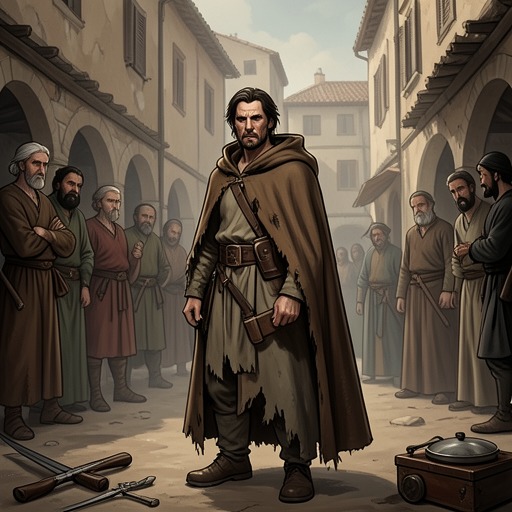
The organization first becomes tangible in the inn through an officer of the Old Holy Brotherhood of Toledo. Hearing the noise of a nighttime conflict, he takes up his staff and the tin case containing his warrants and enters the chamber, calling on those present to stop in the name of the jurisdiction and the Brotherhood. The details define its presence in the scene: not an abstract principle, but an officer equipped to intervene and carrying documents that represent legal authority. The disturbance draws him from his lodging into the room, where Don Quixote’s adventures have become a matter for public order.
Sancho offers a plain account of the Brotherhood’s reach when he distinguishes its business from his own. He understands it to look after people who fight in the fields, while insisting that he has no part in that business. His practical awareness contrasts with his master’s confidence that a knight-errant cannot be brought before a court, regardless of the homicides he may have committed. Don Quixote’s claim rests on the rules of his imagined vocation; Sancho recognizes that the Brotherhood and the law it represents do not share those rules. The scene establishes a central limit of Don Quixote’s self-appointed authority: he can describe his conduct as chivalric, but that description does not cancel the jurisdiction of ordinary officers.
The Galley-Slave Affair and the Flight
The Brotherhood becomes an immediate concern after Don Quixote intervenes on behalf of the galley slaves being transported under guard. He interprets their accounts of punishment, lack of money or advocacy, and possible injustice as a call to fulfil his vow to aid the oppressed. The intervention releases the prisoners, but it does not resolve the legal question of their punishment. Instead, the liberated men drive off the guards, and Sancho foresees that the fugitives will report what happened to the Holy Brotherhood. He expects the alarm bell to bring officers out in pursuit of those responsible.
Don Quixote initially resists treating that danger as a reason to withdraw. He even insists that he would rather remain and face the Brotherhood than let Sancho call his departure cowardice. He ultimately agrees to leave, but only on the condition that Sancho describe the retreat as a response to his entreaties, not as fear. The exchange shows how the threat of enforcement alters their course while Don Quixote struggles to preserve his chivalric reputation. Sancho leads the way into the nearby Sierra Morena, intending to cross it and hide among its crags for several days. Their provisions have survived the disorder, and Sancho regards the intact stores carried by the ass as fortunate; in the mountains, however, the fugitive Gines de Pasamonte also seeks concealment from the Brotherhood. The pursuit thus sends both the released prisoner and the pair into the same refuge, without making them allies.
Sancho later recalls the flight as the setting for a separate loss: while the two slept, someone removed Dapple from beneath him after propping up the pack-saddle on four stakes. His account places the theft on the night they entered the Sierra Morena to escape the Brotherhood. The episode is not presented as an act by the organization, but it records one of the practical consequences of the flight it prompted: hiding from the law leaves Sancho and Don Quixote exposed to further misfortune on the road.
The Warrant at the Inn
The Brotherhood’s pursuit eventually takes documentary form. During a later disturbance at an inn, officers are initially pacified after learning the rank of some of the people involved and withdraw from the contest. One officer, however, remembers that the warrants he carries include an order for Don Quixote’s arrest for setting the galley slaves free. He takes out the parchment, compares its description with Don Quixote’s face, and decides that the identification is certain. He then seizes Don Quixote by the collar and announces that the warrant requires his arrest.
The moment makes the difference between Don Quixote’s reputation as a madman and his status as the subject of a legal order especially clear. The curate tries to persuade the officers that Don Quixote is out of his senses and would soon be released even if they took him away. The officer replies that his task is to execute his superiors’ instructions, not to determine Don Quixote’s sanity. His answer confines his immediate responsibility to the warrant: an assessment of madness does not, in itself, erase the order he has been sent to carry out. At the same time, the officers do not press the arrest to its conclusion in this scene. After hearing the curate’s arguments and witnessing Don Quixote’s conduct, they allow themselves to be pacified.
Their role then shifts from arrest to mediation. Sancho and the barber remain in a bitter dispute over their pack-saddles, and the officers help settle the matter by arbitration. The pack-saddles are exchanged, though the girths and head-stalls are not; meanwhile, the curate secretly pays eight reals for the barber’s basin, which Don Quixote has mistaken for Mambrino’s helmet. The barber gives a receipt promising to make no further claim. This practical settlement does not amount to an adjudication of Don Quixote’s earlier release of the prisoners, but it shows the officers helping restore order amid the same confusion that has drawn them into the inn.
Law and Knight-Errantry
The Brotherhood repeatedly exposes the gap between Don Quixote’s account of justice and the consequences his actions create. At Puerto Lapice, he tells Sancho that the squire must not assist him in a fight with knights unless Sancho has first been dubbed; help is permitted against rabble or base assailants. This is a rule internal to knight-errantry, whereas Sancho’s remarks about the Brotherhood point to an authority operating outside that code. Don Quixote’s later assertion that knights are not brought before courts extends the same imagined exemption to legal accountability. The arrest warrant answers that assertion not through debate about romance, but through an officer’s identification of the accused and execution of an order.
The encounters also keep the conflict from resolving into a simple contest between a coherent institution and a wholly lawless protagonist. Don Quixote understands his intervention as aid to people he believes have suffered unjustly; the Brotherhood’s warrant addresses his responsibility for freeing them. At the inn, its officers enforce an order, yet they also help mediate a quarrel over disputed property. The organization therefore functions in the narrative both as the threat Sancho anticipates and as a practical presence capable of restoring local order. Its recurring interventions make visible what Don Quixote’s chivalric vision cannot: good intentions, claims of injustice, and a self-appointed vocation do not remove actions from the reach of public authority.